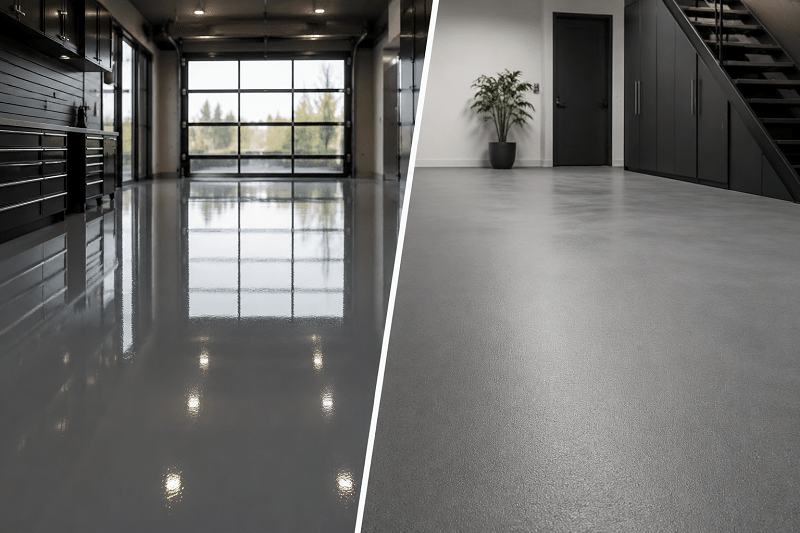
Most floor coating failures are blamed on the primer or the concrete, yet a surprising number begin at the surface. The top layer is the part that meets forklift tires, cleaning chemicals, spilled oil, sunlight and bare feet every day. Choosing the right floor coating topcoat is therefore less about appearance and more about matching a chemistry to the way a floor will actually be used.
This article compares the three families most often specified, explains the technical terms that appear on data sheets, and lists the questions worth asking before anything is ordered.
What a topcoat actually does
In a multilayer system, the primer bonds to the substrate, the body coat or broadcast layer builds thickness and decoration, and the topcoat seals everything. It protects the layers below from abrasion, staining and chemicals, and it sets the gloss level, texture and how easy the floor is to clean. A topcoat cannot rescue a poorly prepared slab, but a poorly chosen one can ruin an otherwise sound system.
Epoxy topcoats
Epoxy is the long established workhorse. It bonds well, builds film thickness and offers good resistance to many chemicals and abrasion. Its main weakness is ultraviolet light. Standard epoxies are aromatic in chemistry, and prolonged exposure to sunlight tends to cause yellowing and chalking. That makes epoxy a sensible topcoat for interior floors such as warehouses, workshops and showrooms, but a risky one for garages with large windows or outdoor slabs.
Cure time is also longer than with newer chemistries, so the floor is out of service for more days, which matters in a working facility.
Polyurethane topcoats
Aliphatic polyurethane topcoats are commonly applied over epoxy to provide UV stability and a more flexible, scratch tolerant surface. They resist color change in sunlight better than epoxy and generally handle abrasion and many cleaning agents well. Application can be sensitive to moisture and humidity during curing, so the working conditions should be checked against the product instructions.
Polyaspartic topcoats
Polyaspartics are a subclass of aliphatic polyurea technology. They are valued for three reasons: color stability under UV exposure, fast cure, and the ability to be applied in a wider range of temperatures than many epoxies. Fast cure can let a floor return to service in a day, though the exact times vary by product and conditions.
The trade offs are practical. Working time, often called pot life, can be short, which means mixed material must be placed quickly and the crew needs to be experienced. Cost per unit is usually higher than epoxy. Some formulations also demand tighter control of surface preparation and moisture.
Reading a data sheet
Several terms appear again and again:
Solids content. This is the percentage of the product that remains on the floor after solvents or volatile components leave. A higher figure usually means a thicker film per coat and lower emissions, but it says nothing on its own about durability.
Pot life and recoat window. Pot life is how long mixed material stays workable. The recoat window is the period during which another coat will bond chemically. Missing it can require abrading the surface before recoating.
Chemical resistance charts. Resistance depends on the chemical, concentration, temperature and exposure time. A floor that survives a brief splash may fail under prolonged immersion. Match the chart to the substances you really use.
Gloss and slip resistance. High gloss looks sharp but shows scratches and can be slippery when wet. Satin or matte finishes hide wear better, and anti slip additives or textured aggregates increase traction. Ask for slip resistance test data where safety matters.
Choosing by environment
For an indoor workshop or warehouse, an epoxy body coat with a polyurethane or polyaspartic topcoat gives abrasion resistance with easier cleaning. For commercial showrooms and retail floors, appearance and cleanability usually lead the decision, so gloss level and stain resistance matter more than extreme chemical exposure. Outdoor slabs, ramps and parking areas, UV stability, thermal movement and traction are the priority, which is where aliphatic topcoats are generally preferred.
Preparation matters more than the product
Whatever chemistry is chosen, results depend on the slab. Concrete should be mechanically prepared, typically by diamond grinding or shot blasting, to a surface profile suited to the coating system. The International Concrete Repair Institute publishes concrete surface profile guidelines for this purpose. Moisture is the other classic cause of failure. Moisture vapor transmission can be measured using standard methods such as calcium chloride testing or in situ relative humidity probes, and high readings may call for a moisture mitigating primer. Cracks, oil contamination and old coatings must be dealt with before anything else goes on.
Documents to request before ordering
- Technical data sheet with mixing ratio, coverage rate and cure schedule
- Safety data sheet for handling and ventilation requirements
- Application instructions, including temperature and humidity limits
- Test reports relevant to abrasion, UV exposure or chemical resistance
- Confirmation that the topcoat is compatible with your primer and body coat
A small sample patch, applied under real conditions and left through a few weeks of service, tells you more than any brochure.
Bottom line
There is no single best product. Epoxy suits protected interiors, polyurethane adds flexibility and UV stability, and polyaspartic offers speed and weather resistance at a higher price and with a steeper application learning curve. Define traffic, chemicals, sunlight, cleaning routine and downtime tolerance first, then select the chemistry that fits, and insist on proper surface preparation. That order of decisions prevents most expensive mistakes.