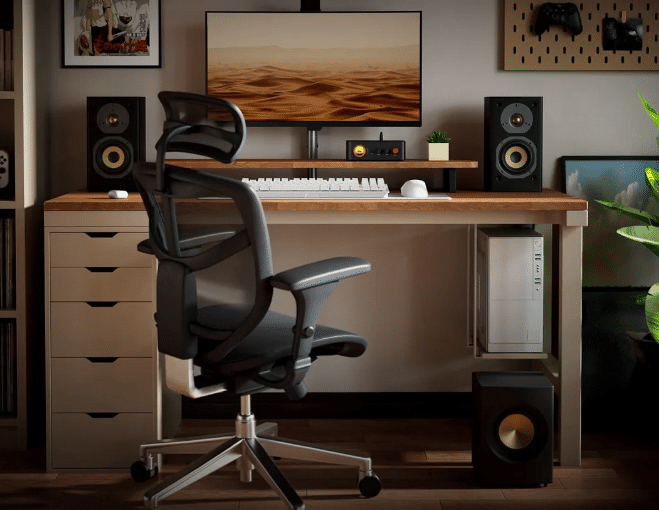
Most advice about home audio assumes the goal is maximum impact. Plenty of people want something simpler: a voice that is easy to understand. That might be a recorded lecture, an audiobook, the news, a language lesson, a video call with relatives or a long recitation played through a desk setup. For this kind of listening, the usual spec sheet numbers matter far less than a handful of practical decisions about speakers, placement, amplification and volume.
This guide explains what actually makes speech clear, and how to build a simple desktop or living room system that delivers it without overspending.
What makes speech intelligible
Human speech covers a surprisingly narrow band. The fundamental pitch of an adult voice sits roughly between 85 and 255 Hz, depending on the speaker, but most of what makes words understandable comes from higher frequencies. Consonants such as s, t, k and f carry much of the information and live largely in the range of about 2,000 to 4,000 Hz. Traditional telephone lines were designed around a band of roughly 300 to 3,400 Hz for exactly this reason: that range is enough to carry intelligible speech.
Three things damage clarity more than anything else:
- Room echo. Hard walls, bare floors and glass extend reverberation, which smears consonants into each other.
- Distortion. Overdriven speakers or amplifiers blur detail, especially at higher volume.
- Background noise. Fans, traffic and air conditioning compete with the quiet parts of speech.
Deep bass does little for speech, and too much can make a voice sound boomy and muddy.
Choosing speakers
Speakers matter more than the amplifier in a spoken word system. Look for a smooth frequency response through the midrange, and for a design that stays clean at moderate volume.
- Bookshelf or desktop speakers with a dedicated tweeter handle the consonant range well.
- Powered speakers have the amplifier built in and simplify setup for a small desk.
- A subwoofer is optional. A 2.1 arrangement, which adds one low frequency channel to a left and right pair, is helpful for television and general use, but for pure speech you can leave the subwoofer level low or set the crossover so that it only handles the deepest notes. Crossover settings around 80 Hz are common.
Check sensitivity and impedance in the specifications. Sensitivity indicates how loud a speaker gets for a given power, and impedance, measured in ohms, must be compatible with the amplifier. A mismatch can cause overheating or poor output.
Placement and the room
You can improve clarity for free by moving things.
- Place speakers at ear height when seated, angled slightly toward you.
- Keep a roughly equal distance from each speaker to your listening position.
- Avoid pushing speakers into corners, which exaggerates bass.
- Add soft materials such as curtains, rugs and bookshelves to absorb reflections.
A rug and a few cushions often do more for intelligibility than a more expensive amplifier.
Amplifier types in plain language
An amplifier takes a weak signal from a phone, computer or television and increases it enough to drive speakers. The main families are:
Solid state (transistor) amplifiers. These are compact, efficient, cool running and long lasting, and they are the default choice in most homes.
Class D amplifiers. A switching design that is very efficient and small, common in modern desktop units and powered speakers.
Vacuum tube designs. A tube amplifier uses glass vacuum tubes instead of transistors to boost the signal. It runs warmer, needs ventilation, relies on a heavy output transformer, and needs its tubes replaced from time to time. Some audio fans choose one for the craftsmanship, the repairable design or personal preference, and a well-built unit can perform cleanly. For clear voices, the amplifier type matters less than low distortion, good speakers, and a quiet room, so any well-designed amplifier can do the job.
How much power do you need
For desks and small rooms, a few tens of watts per channel is typically more than enough. A useful rule of thumb is that a 10 decibel increase sounds roughly twice as loud, and getting that increase takes about ten times the power. In other words, a bigger amplifier brings diminishing returns, while speaker sensitivity and distance make a larger difference. Headroom matters more than headline watts, because it lets sudden louder moments pass without distortion.
Connections and source quality
Many modern amplifiers offer Bluetooth, USB, optical and analog inputs. Wired connections generally give the most stable result. Bluetooth is convenient, but it adds a small delay, which can make lips and voices drift out of sync when you watch video, so check whether your devices support low latency modes. If you hear a hum, the cause is often a ground loop or a poor cable, not the amplifier itself.
Protect your hearing
Clear audio should not need high volume. Public health bodies commonly cite 85 decibels as the level at which prolonged daily exposure begins to risk hearing damage. If you often turn the volume up because speech is hard to follow, fix the cause instead: move the speakers closer, reduce room echo or lower background noise. Take short breaks during long sessions.
A simple setup checklist
- Pick a pair of speakers with a clean midrange, ideally powered.
- Place them at ear height, equidistant and away from corners.
- Soften the room with rugs, curtains and furniture.
- Use a wired connection when possible.
- Keep any subwoofer level low and the crossover modest.
- Test with a familiar voice recording and adjust until it sounds natural at a moderate volume.
Final thoughts
Good audio for speech is not about owning the most powerful equipment. It is about delivering a clean midrange, controlling the room and listening at a comfortable level. Get those three right, and even an inexpensive system will make spoken content easy to follow for hours at a time.