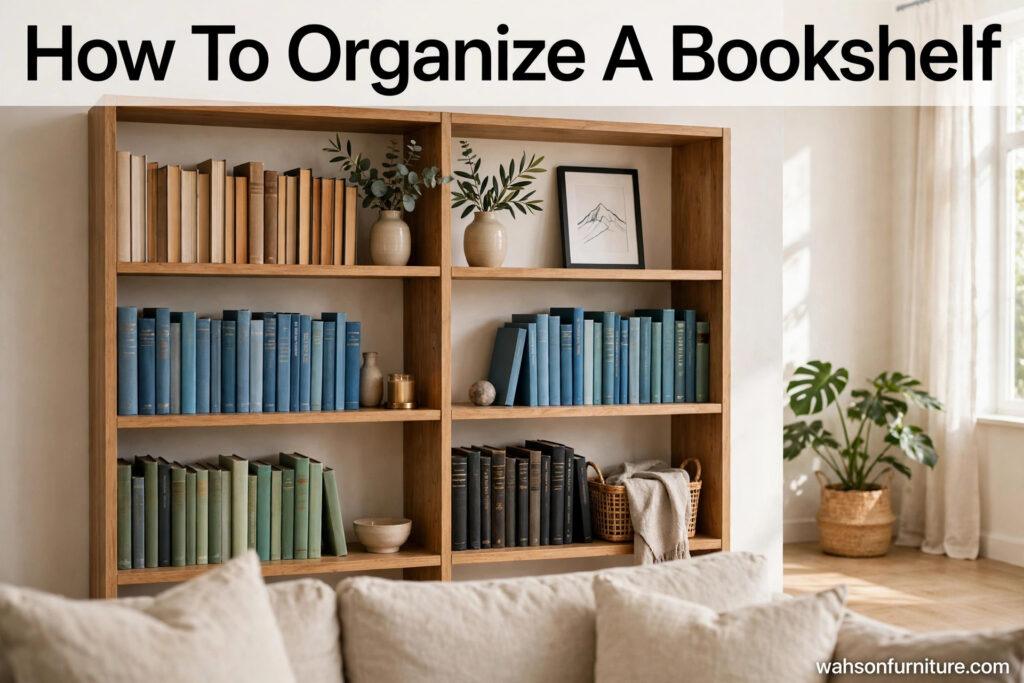
A bookshelf should be one of the easiest pieces of furniture to keep tidy, yet it is often the first place where clutter gathers. Books arrive in piles, get squeezed into gaps, and end up stacked sideways on top of rows that are already full. Learning how to organize a bookshelf is less about buying clever storage and more about making clear choices: which books stay, how they are grouped, and what else, if anything, earns a place on the shelf. This guide walks through a simple method that works for any shelf.
Empty the Shelf and Start Fresh
The fastest way to a tidy shelf is to take everything off it first. Empty shelves show you exactly how much space you have, and a pile of books on the floor shows you exactly how many books you own. Sort the pile into three groups: books you love and will read again, books you have not read yet but still want to read, and books you can pass on. Be honest with the third group, because a shelf that holds only books you care about is far easier to organise than one packed with books you keep out of guilt. For a wider view of how rooms are balanced, see our interior decoration tips. Once the shelf is empty and clean, you have a blank space to fill with intention rather than a crowded space to squeeze things into.
Sort by How You Actually Find Books
There is no single correct way to sort books, so choose the system that matches how you look for them. Grouping by subject works well for most homes: cookbooks together, novels together, children’s books together, and reference books together. Within each subject, arrange books by author or by size, whichever feels easier to scan. Sorting by colour looks striking in photographs, but it makes finding a particular book much harder, so save it for shelves where the books are mostly decoration. Leave a little breathing room on every shelf, because a shelf packed to the very edge has no space for a new book and no space for a small decorative object. Our guide to decorating a console table shows the same idea on a smaller surface: group by purpose, leave space, and let a few pieces stand out.
Place Books Upright, With Room to Breathe
Stand most books upright, spines facing out, with the tallest books at the ends of a row where they can act as bookends. If a row is too short to fill a shelf, lean the last few books gently against a bookend or a heavy object rather than letting them flop sideways. Keep heavy books on lower shelves, where they are easier to lift and where they will not fall on anyone, and keep the books you reach for most often at eye level. When you are deciding how to organize a bookshelf in a shared home, agree the system with the people who use it, because a shelf only one person understands will be messy again within a week.
Add Objects, But Only a Few
A bookshelf that holds only books can feel heavy, while a shelf crowded with objects feels messy. The balance is to leave about a quarter of each shelf free and to add objects only where they help the eye rest. A small vase, a framed photograph, a clock, or a single plant is enough. Soft textures work well against rows of books, and our velvet decorative pillows show how one repeated colour can pull a whole room together. If you love collections, give them one shelf of their own rather than scattering them across every shelf, and keep the rest of the shelves for books. For more small-space inspiration, see our home decor ideas.
Keep Children’s and Shared Shelves Simple
Shelves used by children need a simpler system than shelves used only by adults. Put children’s books at their height, spines facing out, and group them by size or by series so a child can find a favourite without pulling every book out. A basket on the lowest shelf holds picture books and soft toys, and a clear rule — one book out, one book back — keeps the shelf working without daily nagging. In a shared living room, give each person one shelf or one section, so everyone knows which part is theirs to keep tidy. A shelf that is easy to use is a shelf that stays tidy, and the same grouping idea works across the whole home: our guide to a homeware zone shows how to group everyday essentials by the job they do.
The Weekly Habit That Keeps It Tidy
A tidy shelf is not a shelf that is organised once; it is a shelf with a small habit behind it. Once a week, walk past the shelf and return any book that has wandered to another room. Once a month, look at the shelf with fresh eyes and ask whether anything on it still earns its place. When the shelf starts to feel full, it is time to pass on a few books, not to buy a second bookcase. Knowing how to organize a bookshelf is really about this habit more than the first big sort: the shelf you maintain a little at a time is the shelf that stays tidy long after the first sort.
Conclusion
A well-organised bookshelf does two jobs at once: it keeps your books easy to find and it makes the room look calm and considered. Start by emptying the shelf, keep only the books you truly want, sort them the way you search for them, and leave room for a few objects and a few new arrivals. Learning how to organize a bookshelf is a small skill with a large reward, because the shelf you see every day shapes how the whole room feels.