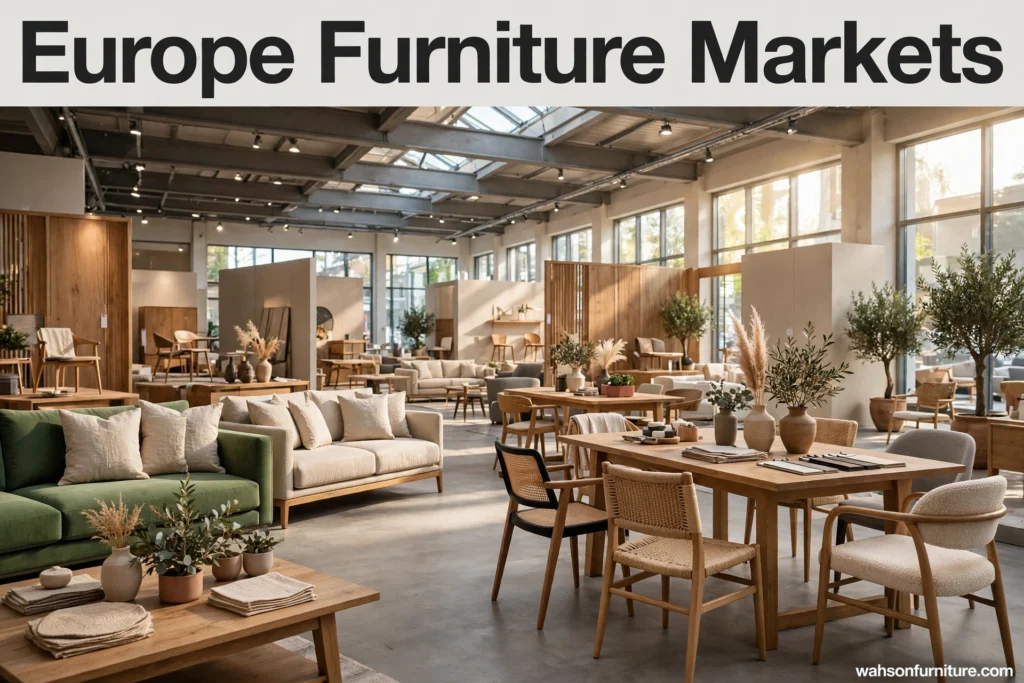
Europe furniture markets are the trade fairs where the continent’s furniture is launched, ordered and judged — Milan in April, Paris and Cologne in January, Stockholm in February — plus the public antique and flea markets where older pieces change hands. This guide explains what each fair is for, who should go, and how to plan a visit.
Key Takeaways
- The four fairs that set the European calendar are Milan, Paris, Cologne and Stockholm.
- Milan sets design trends; Paris and Cologne are where buyers place orders.
- Most big fairs are trade events first — check whether the public is admitted, and on which days.
- Book hotels before anything else: room rates rise sharply during fair weeks.
- Antique and flea markets are a separate world, and need a different plan.
- Confirm every date with the organiser before paying for anything.
What The Term Actually Covers
The phrase covers two different things, and mixing them up is the most common mistake. In the furniture trade it usually means the big international fairs: exhibition halls where manufacturers show new collections to retailers, designers, architects and press. In everyday shopping it can also mean the public markets — flea markets, antique fairs and vintage halls — where anyone can walk in and buy a single piece.
Europe furniture markets in the trade sense are business events: stands built like small showrooms, orders negotiated on the spot, and many halls closed to the public on the main days. Public markets work the other way round: no badge, no appointment, and the piece you see is the piece you take home.
The Four Fairs That Set The Calendar
Milan — Salone del Mobile
The Salone del Mobile in Milan is the largest furniture fair of its kind in the world, held every year, usually in April, at Fiera Milano in Rho. Launched in 1961 to promote Italian furniture, it sets the year’s design trends: the collections, materials and colours shown here appear in showrooms over the following twelve months. The fair covers around 210,000 square metres, and SaloneSatellite, founded in 1998, shows work by designers under 35.
Milan is also a city-wide event: Fuorisalone, the programme of exhibitions and showroom openings across the city, runs alongside the fair and is largely free. Trade visitors get the best access on weekdays; the public is usually admitted only on the final weekend.
Paris — Maison&Objet
Maison&Objet in Paris is the lifestyle and interior design showcase, held twice a year, in January and September, at Paris Nord Villepinte. Launched in 1995, it covers furniture alongside decor, lighting, tableware and accessories. Buyers can compare many suppliers in one trip, but should filter the exhibitor list by category first, because decor makes up a large share of the halls.
Cologne — imm cologne
The imm cologne fair in Cologne, Germany, is one of Europe’s oldest furniture fairs, held every January at Koelnmesse. German and European manufacturers show complete home ranges, and buyers negotiate orders, lead times and minimum quantities at the stands. Trains reach the halls directly, but hotels fill up during fair week.
Stockholm — Stockholm Furniture Fair
The Stockholm Furniture Fair, held in February, is the home of Scandinavian design: small, edited collections in neutral palettes and pale woods, in a fair far easier to cover than Milan or Cologne. It suits buyers sourcing Scandinavian pieces specifically.
| Fair | City | When | Best for |
|---|---|---|---|
| Salone del Mobile | Milan, Italy | April | Design trends, new launches, press |
| Maison&Objet | Paris, France | January and September | Ordering furniture, decor and lifestyle |
| imm cologne | Cologne, Germany | January | Ordering home furniture, German makers |
| Stockholm Furniture Fair | Stockholm, Sweden | February | Scandinavian design, edited ranges |
| Orgatec | Cologne, Germany | October, every two years | Office and workplace furniture |
| London Design Fair | London, United Kingdom | September | British design, smaller makers |
Which Fair Fits Your Reason For Going
The right fair depends on what you want from the trip. Buyers who write orders should go to Paris or Cologne, where suppliers expect to negotiate and quote. Designers should go to Milan, where the new work is shown first. Contract specialists specifying offices should go to Orgatec in Cologne, which runs every two years and focuses on workplace furniture — it shows little residential furniture, so home retailers gain little from it.
| You are | Go to | Why |
|---|---|---|
| A retailer placing orders | Paris or Cologne | Suppliers quote prices, quantities and lead times |
| A designer sourcing ideas | Milan | New collections and trends appear here first |
| An architect specifying offices | Orgatec, Cologne | Workplace furniture, seating and acoustics |
| A Scandinavian design buyer | Stockholm | Edited Nordic ranges, easy to cover |
| A home shopper, not a trader | Fuorisalone or a flea market | Open to the public, no badge needed |
One fair per season is usually enough. A buyer who tries to cover Paris and Cologne in the same January week will miss opening days and arrive exhausted; each fair needs two or three full days. Pick the one whose exhibitor list matches the products you actually buy, and skip the rest however famous they are.
The Public Markets: Antiques, Vintage And Flea
Away from the trade halls, Europe’s public furniture markets are where older pieces are bought and sold. The best known is the Marché aux Puces de Saint-Ouen in Paris, a large flea market north of the city with hundreds of stalls and shops selling antiques, vintage furniture, lighting and decorative objects. Similar markets exist in most large European cities, from weekend antique markets in France to flea markets in London and Berlin.
Shopping these markets is a different skill from walking a trade fair. Condition matters more than style: check joints, drawers, veneer and repairs before you buy, because most sales are final. Measure the piece and your doorway first, and ask about delivery — a large wardrobe needs a van, not a taxi. Our guide on vintage furniture explains how to tell a genuinely well-made old piece from a dressed-up reproduction. A luxury furniture budget is not needed here: the best finds are often the pieces that need a little work, not the ones already restored and priced as antiques.
How To Plan A Visit
Europe furniture markets reward planning more than spontaneity, and the plan starts with the hotel, not the ticket. Room rates exceed admission fees at every major fair, and Milan in April and Cologne in January carry the sharpest increases, so book a room with free cancellation as soon as the dates are confirmed. Pre-registering online usually costs less than buying a badge at the door — but read the admission rules first, because some fairs restrict certain days to trade visitors and a badge bought for the wrong day is wasted.
Book meetings six to eight weeks ahead if you are buying. Arrive with a specification sheet for each product — dimensions, materials, finish codes and quantity — and ask for lead times, minimum quantities and payment terms in writing. Landed cost, including shipping, decides the order, not the unit price. A recent trade-show guide gives the 2026 dates and the same role-based advice. At home the same discipline helps: our guide on dining room furniture shows how to choose a set by measuring first, and outdoor furniture and patio covers what to check before buying pieces that will live outside.
At the fair, pick two or three halls before you arrive and match each to the categories you buy — Milan is too large to cover in one day. Schedule the most important meetings for the mornings and keep one day free for the city programme. Note each supplier’s reference number, and confirm colour and finish tolerances in writing before paying a deposit.
Mistakes To Avoid
Five mistakes catch visitors out. First, the wrong fair for your purpose — Milan for orders, or Cologne for inspiration alone. Second, booking the hotel last, when only expensive rooms remain. Third, trying to see everything: a fair with thousands of exhibitors cannot be covered in a day. Fourth, buying a market piece without measuring it — a wardrobe that fits the stall may not fit your stairwell, and our guide on how to assemble furniture is no help if the piece cannot get through the door. Fifth, treating a quoted price as the final cost: ask whether delivery, taxes and assembly are included.
Frequently Asked Questions
What is the biggest furniture fair in Europe?
The Salone del Mobile in Milan, held every April at Fiera Milano in Rho. Founded in 1961, it covers around 210,000 square metres, with thousands of exhibitors and a young-designer section, SaloneSatellite.
Can the public visit these fairs?
It depends on the fair and the day. Most big fairs are trade events first, and the public is often admitted only on the final weekend, if at all. Fuorisalone in Milan and the public flea markets are open to everyone.
Which fair is best for buying furniture for a shop?
Paris and Cologne in January are the order-writing fairs: suppliers expect to negotiate prices, quantities and lead times. Milan sets trends but is harder for order writing, because crowds slow down buying meetings.
When do the fairs take place?
Milan is in April, Paris in January and September, Cologne in January, and Stockholm in February. Orgatec in Cologne runs every two years in October. Exact dates shift each year, so confirm them with the organiser before booking travel.
Are there furniture markets for ordinary shoppers?
Yes. Public flea and antique markets — Saint-Ouen in Paris is the best known — sell single pieces to anyone, with no badge or appointment. Check condition and measurements, and arrange delivery before you pay.
Do I need to register in advance?
Yes, for the trade fairs. Pre-registering online is usually cheaper than buying at the door, and some fairs require proof of a trade or business.
Conclusion
Europe furniture markets are worth the trip when the fair matches the reason you are going: Milan for trends, Paris and Cologne for orders, Stockholm for Scandinavian design, and the public flea markets for one-off vintage finds. Choose one fair per season, book the hotel first, arrive with a list, and confirm every date with the organiser before you pay. The best visit ends with two or three solid suppliers — or one good piece for your own home.