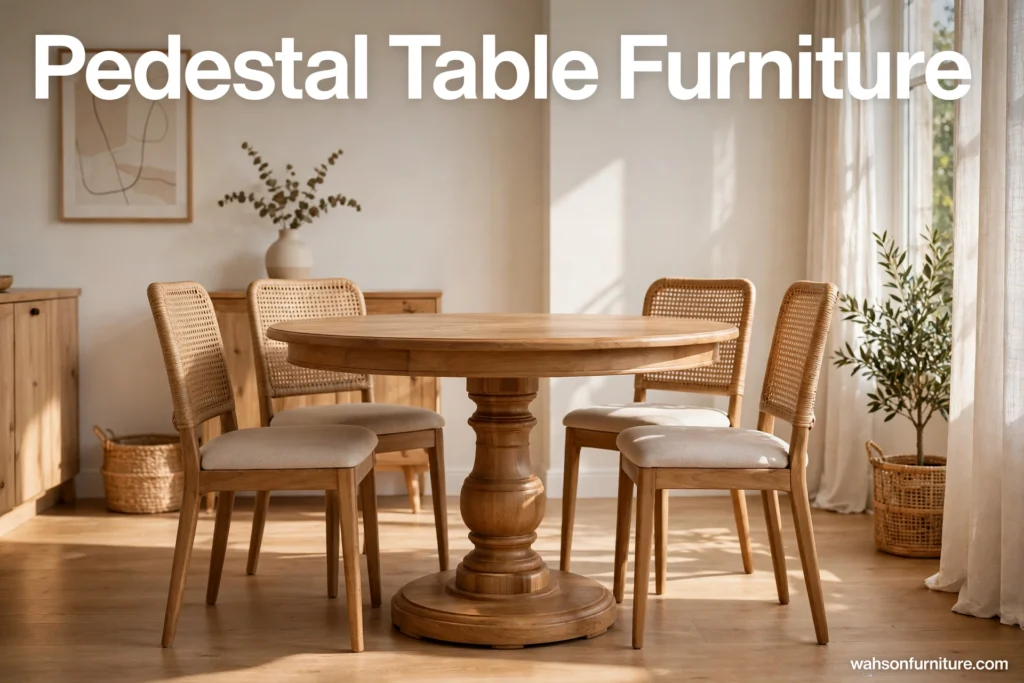
Pedestal table furniture is dining and occasional tables supported by one central column — or two columns joined by a stretcher — instead of four corner legs. The design frees legroom on every side, suits round and oval tops best, and works in small kitchens and formal dining rooms alike, provided the base is wide and heavy enough.
Key Takeaways
- A single column suits round tops to 48 inches; larger tops need a double pedestal.
- The foot should span at least a third of the top’s width — that ratio decides stability.
- Round tops seat everyone equally; oval and rectangular tops seat more people.
- Solid wood tops can be refinished; stone tops are heavy and need a strong base.
- Leave 36 inches of clearance around the table for chairs to pull out.
- Check the bolts where the column meets the top every few months.
What A Pedestal Table Actually Is
A pedestal table is any table whose top rests on one central support rather than four legs at the corners. The support can be a solid column, a flared trumpet shape, a cross-foot design, or a sculpted form in wood, metal or stone, and the top is usually bolted to a central mounting plate. The idea is old: pedestal-style tables appeared in Georgian dining rooms and mid-century American kitchens alike. All the weight must travel through one central point, so the base has to be stronger and better anchored than a single leg of a four-leg table.
Pedestal table furniture differs from a four-leg table in one practical way: there is nothing at the corners to block a chair or a knee. Every seat offers full legroom and easy entry, which is why the design is prized in small kitchens and breakfast nooks. The trade-off is stability: four legs give natural four-point stability on an uneven floor, while a single column depends entirely on the width and weight of its foot and on a tight connection to the top.
The Four Base Types
The base is the defining feature — choose it first. A single column pedestal is one central column with a wide, weighted foot, best for round and square tops to about 48 inches — ideal for breakfast nooks and small kitchens. A double pedestal, or trestle, is two columns joined by a horizontal stretcher, supporting rectangular or long oval tops for six to eight diners, with a grander, more formal look. A tulip or trumpet base is a sculpted single piece that flares at the floor, a mid-century modern favourite, easy to clean under and visually light in small rooms. A turned wood pedestal is a carved column-style base with decorative turning, suited to traditional, farmhouse and transitional rooms, usually with round or oval wooden tops.
| Base type | Best top | Seats | Watch out for |
|---|---|---|---|
| Single column | Round/square, to 48 in | 2–6 | Needs a wide foot |
| Double pedestal (trestle) | Rectangle/long oval | 6–8 | Bulky in small rooms |
| Tulip / trumpet | Round, small–medium | 2–4 | Light tops only |
| Turned wood | Round/oval wood | 4–6 | Heavy; hard to move |
A buying guide from Colder’s makes the same distinction: double pedestals add formal elegance to larger rooms, single pedestals suit smaller, more intimate settings. Match the base to the room before falling in love with a top.
Top Shapes And Sizes
Pedestal tables pair most naturally with curved tops, which have no corners sticking out past the base. A 36-inch round top seats two to four people, a 48-inch round seats four to six, and a 54- to 60-inch round seats five to six. Oval tops from 60 to 72 inches seat about six, and tops from 72 to 96 inches seat six to eight — but those long tops need a double pedestal. Our guide on dining room furniture covers the same measuring-first approach.
Size the room as well as the table: allow 24 to 30 inches per seat, and at least 36 inches between the table edge and walls or counters. A detailed sizing guide adds a useful rule: the base foot should span at least one-third of the top’s width, and if children regularly lean on the table edge, favour a wider foot or a double pedestal. Check that chair legs do not collide with the foot when tucked in.
| Top size | Comfortable seating | Fits |
|---|---|---|
| 30–36 inch round | 2–3 people | Small nook |
| 42–48 inch round | 4 people | Breakfast area |
| 54–60 inch round | 5–6 people | Medium kitchen |
| 60–72 inch oval | 6 people | Large kitchen |
| 72–96 inch oval or rectangular | 6–8 people | Open dining |
Materials: Tops And Bases
Solid hardwood tops in oak, maple or walnut are durable, warm and refinishable: a thick top resists warping and can be sanded back to new. Engineered wood with veneer gives consistent grain and stays stable when humidity changes, at a lower price, though veneer chips if knocked and cannot be sanded. Stone or marble tops are luxurious and heat-resistant, but heavy — a stone top on a light base is the classic pedestal mistake, so the base must be rated for its weight. Glass tops look light, make small kitchens feel larger and wipe clean, but need tempered glass with a bevelled edge. For the base, solid wood is traditional and repairable, steel or iron gives a sleeker industrial look, and stone or concrete suits sculptural designs.
A luxury furniture budget is not required, but material is where cheap tables show first: a thin top on a narrow foot will wobble within a year, while a thick top on a wide foot will outlast the chairs. Ask the seller for the base weight and foot diameter before you buy.
Where These Tables Work Best
The best room for a single pedestal is a small one. In a breakfast nook or a compact kitchen, a round pedestal table seats four where a four-leg table of the same size seats three uncomfortably. In a formal dining room, a double-pedestal rectangular table seats eight. Round pedestals also suit entryways and living rooms as occasional tables. What they do not suit is a room where the table doubles as a workbench: heavy leaning on one edge will test a single column in a way four legs never notice. Our guide on vintage furniture explains how to judge an older pedestal table, where the column-to-top joint is usually the first thing to fail. Outdoors, the same logic applies: our guide on outdoor furniture and patio covers what to check before buying pieces that will live outside.
How To Choose The Right One
Pedestal table furniture rewards a short checklist more than a long search. First, measure the room and subtract 72 inches from each dimension — 36 inches of clearance on both sides — for the largest top the room can take. Second, match the base to the top: single column to 48 inches round, double pedestal beyond that, with a foot at least a third as wide as the top. Third, sit at it: pull a chair in and lean gently — a good table stays put. Fourth, check the hardware: a reinforced mounting plate where the column meets the top, and levelling glides for uneven floors. Fifth, match the top to your household: stone and glass forgive heat but not knocks, wood forgives knocks but not standing water.
Delivery and assembly deserve the same attention. Most pedestal tables arrive in two parts, and the top is the heavy one — get a second person to help lift it, tighten every bolt to the instructions, and re-check them after a month, because loose hardware is the most common cause of wobble. Our guide on how to assemble furniture covers the same approach for flat-pack pieces. If the table wobbles, adjust the levelling glides first, then the column-to-top bolts, and only then suspect the floor.
Mistakes To Avoid
Five mistakes catch buyers out. First, a top too big for its base — a 60-inch top on a narrow foot will tip when someone leans on the edge. Second, buying for the room you wish you had: a double pedestal in a small kitchen crowds the space it should open up. Third, forgetting the foot when measuring: chairs that hit the foot cannot tuck in. Fourth, choosing stone without checking the base rating, then finding the column flexes under the weight. Fifth, ignoring the bolts: one tight connection holds the whole table, so a table never re-tightened will rock within a year — and the fix is a spanner, not a new table.
Frequently Asked Questions
Are pedestal tables sturdy?
Yes, when built well. Stability depends on construction quality and the size of the base relative to the top: a wide, solid base supports regular use, while very large or heavy tops need double pedestals.
What size round pedestal table seats four people?
A 42- to 48-inch round top seats four comfortably. A 36-inch round seats two to four, and a 54-inch round seats five to six — but check the foot.
How do I fix a wobbly pedestal table?
Adjust the levelling glides on the base foot first. If the wobble persists, tighten the bolts that connect the pedestal to the top and the base. Uneven floors are the most common cause, and a wide foot with glides solves most cases.
Round or rectangular — which shape is better?
Round tops suit small rooms and conversation, because everyone sits at an equal distance. Rectangular tops suit larger families and formal dining, but need a double pedestal and a bigger room.
What is the best material for a pedestal table top?
Solid hardwood is the best all-rounder: durable, warm and refinishable. Stone suits formal rooms, glass suits small kitchens, and veneer suits tighter budgets.
Can I put a pedestal table on a rug?
Yes. Choose a round rug extending at least 24 inches beyond the table edge, and make sure the foot sits flat. A wide foot is stable on most rug piles, but a small foot can rock on a thick rug.
Conclusion
Pedestal table furniture earns its place by removing the thing nobody likes about a dining table: the corner leg. Choose the base before the top, keep the foot at least a third as wide as the top, leave 36 inches around it, and check the bolts twice a year. Do that, and one column will serve a small kitchen or a formal dining room for decades.