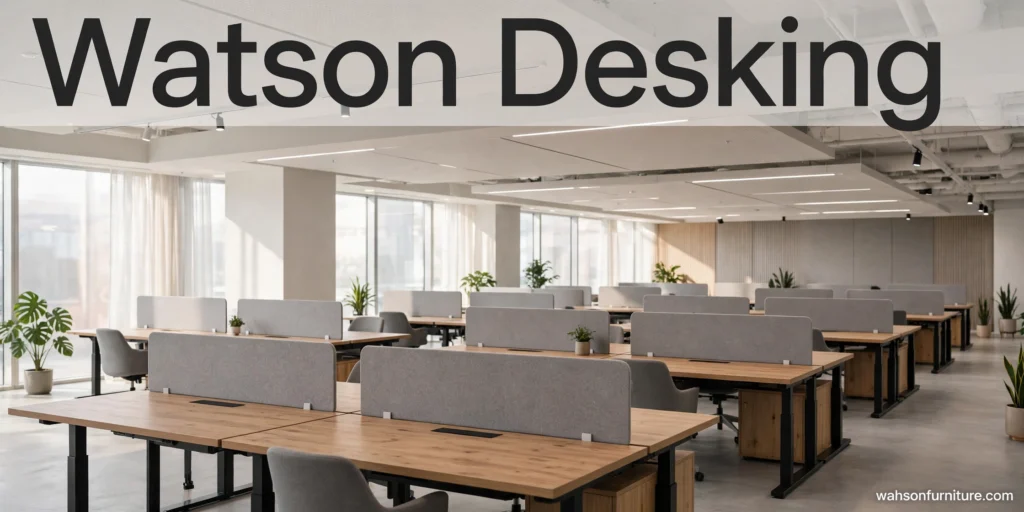
Watson Desking is the desking brand of Watson Furniture Group, covering the desks and workstations a modern office is built around: freestanding desks, height-adjustable desks, benching, and the storage that goes with them. It is one of the company’s three brands, alongside Dispatch consoles and Magna Design casegoods, and its lines have names such as Miro, M2, SEVEN, ZO, Fusion, and Frames. This guide explains what each line does, who it suits, and what to check before you buy.
Key Takeaways
- The desking brand covers freestanding and height-adjustable desks, workstations, and storage.
- Its lines include Miro, M2, SEVEN, ZO, Fusion, Frames, Tia, and Tonic.
- Height-adjustable desks let people sit or stand through the working day.
- SEVEN is a universal-handed system: flip the surface and left becomes right.
- The newest line, Zo Office, pairs workstations with integrated storage in four models.
- Desking products are made to order in Poulsbo and sold through authorised dealers.
- Choose by how the office works — private offices, open plan, or team neighbourhoods — not by looks alone.
What Is Desking, And What Does The Brand Cover?
Desking is the industry word for the desks and workstations that fill an office, and the brand covers the whole system: the worksurface, the base that lifts it, the storage underneath and beside it, and the screens that divide one seat from the next. A single desk is only the starting point. A desking system lets a whole floor be planned, rearranged, and expanded without starting again, which is why offices buy systems rather than loose desks.
The brand’s lines each solve a different problem. Miro is the private-office line: bold, rectilinear desks with traditional appeal, built for executives and managers who want an updated alternative to conventional casegoods, and used in real projects such as the faculty offices of the Fay Jones School of Architecture. M2 and Fusion cover open-plan and team working. Frames is the structural family that holds a workstation together. Tia and Tonic are height-adjustable workstations with integrated storage, aimed at private offices. SEVEN, the oldest of the modern lines, was designed for lean organisations that need to manage inventories of desk shapes without worrying about left- and right-handed versions.
Watson Desking includes Miro, M2, SEVEN, ZO, Fusion, and Frames, according to the company’s own federal supply schedule records, with Tia, Tonic, and the Bahn range listed in its later certifications. That breadth is the point: one brand, many configurations, so a private office, an open floor, and a meeting area can all be fitted from the same family of parts, finishes, and storage.
Height-Adjustable Desks: How They Work
The most useful idea in the range is the height-adjustable desk. A lifting base raises and lowers the worksurface, so the same desk serves sitting and standing through the day. Some lines adjust with a crank handle — on SEVEN, for example, the crank sits on the shallow end of the desk — while others use electric lifting columns. The company’s dispatch desks use the same lifting technology, with monitor supports that adjust separately, so the idea runs through the whole catalogue.
Height adjustment matters because people and tasks change through the day. A morning of focused writing suits sitting; an afternoon of calls suits standing; a shared desk suits two people of different heights. That is why adjustable desks now sit at the centre of most office plans — a point our guide to office furniture trends in 2026 makes in detail.
There is a practical side too. Adjustable desks need power, cable management, and space for the base to move, so plan the floor before you order. Measure the room, count the seats, and note power and data points, just as you would when setting up a home workspace — our guide on how to set up my home decoradtech covers the same habit of planning power and layout first, and diy home automation shows how desks and technology now sit together. For storage, keep it close: a desk with its own storage underneath saves more floor space than a separate cabinet.
SEVEN, Miro, And The Older Lines
SEVEN deserves a closer look, because it shows how the company thinks. Its worksurfaces are finished seamlessly on both sides, so flipping a surface turns a left-handed desk into a right-handed one. That single detail lets a facilities team manage one inventory of shapes instead of two, and it lets a desk move from one side of a room to the other without a new order. Its dividing screens give light-scale space division in two heights, and once assembled they can be repositioned along the utility beam without tools. A vertical cable channel hides cables along the leg. Nothing about SEVEN is decorative: every feature saves time, stock, or floor space.
Miro works differently. It is a private-office line, and its appeal is visual as much as practical: clean lines, modular construction, and components that can be added as needs grow. It was designed for progressive organisations whose leaders wanted something better than conventional desks. Together, SEVEN and Miro show the brand’s two sides: one line that solves the facilities manager’s problems, and one that solves the executive’s.
The newer lines build on the same ideas. The company’s own press release for Zo Office describes it as a collection that defines team neighbourhoods, establishes individual focus zones, and supports private and shared office environments, and says it was inspired by Tia, an earlier height-adjustable workstation with integrated storage. Zo Office comes in four distinct models, which decide how a worksurface is oriented to its integrated credenza, what shape the worksurface is, and how many there are. It can be seen in the company’s Seattle showroom and was featured in its Chicago showroom during NeoCon 2024.
| Line | What it is | Who it suits |
|---|---|---|
| Miro | Private-office desks and casegoods | Executives and managers |
| M2 | Open-plan desking | Team floors and shared offices |
| SEVEN | Universal-handed desking system | Facilities teams managing stock |
| ZO / Zo Office | Workstations with integrated storage | Team neighbourhoods and focus zones |
| Fusion | Desking and storage family | Mixed open-plan and private offices |
| Frames | Workstation structures | Offices building a system from parts |
| Tia / Tonic | Height-adjustable workstations | Private offices needing storage |
How Do You Buy A Desking System?
Because the furniture is made to order, prices are quoted per project through an authorised dealer rather than listed on a retail shelf. Start with the company’s own website or call the Poulsbo factory on (360) 394-1300, and a dealer can quote, plan delivery, and arrange installation. Government buyers can also order through the company’s federal supply schedule. For everyone else, the dealer is the route — there is no direct online shop.
Ask the dealer three questions before you confirm. First, which line fits your floor: private offices, open plan, or a mix? Second, how many seats, and how will they change over the next few years? Third, what storage and power does each seat need? The answers decide the line, the configuration, and the price. For the wider picture, read our overview of Watson Furniture, which explains the three brands and the Poulsbo factory, and our guide to Watson Furniture Group, which covers the company’s history and its brands in one place.
The desking range is also certified for indoor air quality: the company’s desking and storage products, including Fusion, M2, Miro, Seven, Tia, Tonic, and Zo, were certified Indoor Advantage Gold for low emissions. If your project has sustainability requirements, ask the dealer for the current certification — the certificate on file ran from July 2023 to June 2024, so confirm it is current before you rely on it.
| Before you buy | What to check |
|---|---|
| Floor type | Private offices, open plan, or team neighbourhoods |
| Seat count | How many now, and how many in two years |
| Adjustment | Crank or electric lift, and who adjusts it |
| Storage | Integrated credenza, pedestal, or separate cabinet |
| Power and cables | Cable channel, power points, and data at each seat |
| Buying route | Made to order; quote and installation through a dealer |
Frequently Asked Questions
What is Watson Desking?
Watson Desking is the desking brand of Watson Furniture Group, covering desks, workstations, and storage for offices. Its lines include Miro, M2, SEVEN, ZO, Fusion, and Frames, with Tia and Tonic as height-adjustable workstations. The furniture is made to order at the company’s Poulsbo factory and sold through authorised dealers.
What is the difference between Miro and SEVEN?
Miro is a private-office line with bold, rectilinear desks for executives and managers. SEVEN is a universal-handed desking system for open-plan and lean organisations: its surfaces are finished on both sides, so flipping one turns a left-handed desk into a right-handed one, which simplifies stock and rearrangement.
What is Zo Office?
Zo Office is the company’s newest desking collection, pairing height-adjustable and fixed-height workstations with integrated storage. It comes in four models, defined by how the worksurface relates to its credenza, and is designed for team neighbourhoods, focus zones, and shared offices. It was inspired by the earlier Tia workstation.
Are the desks height-adjustable?
Many of them are. The range includes fixed-height desks and height-adjustable workstations, with crank or electric lifting bases depending on the line. Height adjustment lets the same desk serve sitting and standing through the day, and lets shared desks suit people of different heights.
Can I buy a Watson desk for my home?
You can ask a dealer, but the range is built for workplaces: made to order, sold through dealers, and sized for offices. Check the size, the lead time, and the dealer terms first, and compare with home desks before you order.
Where are Watson desks made?
At the company’s factory in Poulsbo, Washington, where its headquarters also sits. The furniture is made to order there and sold through authorised dealers, with delivery and installation arranged through the dealer.
Conclusion
Desking is the quiet backbone of an office: the desks, the bases that lift them, the storage beside them, and the screens between them. This brand covers all of it, from the private-office lines to the systems that fill an open floor, and its best ideas — a surface that flips from left to right, a workstation with its storage built in — are practical rather than decorative. Choose by how the office works, get the quote through a dealer, and plan the power and the storage before the desks arrive.